Little Joe Moroka
Heart of the HunterLittle Joe Moroka is a soldier under Captain Tiger Mazibuko who encounters Thobela Mpayipheli twice during the pursuit: first at a rain-soaked roadside position, then beneath a bridge near the river. His story turns on the gap between trained reaction and deliberate choice. Initially he is an exhausted member of a search party, caught unprepared by the fugitive; later, an attempt to regain control in a sudden confrontation ends in his death.
Identity and Service
Moroka is stationed with fellow soldier Koos Weyers near the Sneeukraal turn-off, west of the N1 and south of the Three Sisters roadblock. The two have been dropped off near a bend and left standing in the rain with R6 assault rifles. They have gone about twenty-four hours without proper sleep, and their fatigue shows in their aching heads, strained eyes, and unsteady legs. Their conversation drifts to an imagined breakfast, a small moment of ordinary companionship set against a cold, prolonged operation.
That weariness matters to the first encounter. Rain muffles the approach of Mpayipheli’s motorcycle, while mud and poor visibility limit what the soldiers can register. The narrative does not present Moroka as simply careless: later, he will criticize himself for standing too close to Weyers and for talking instead of remaining alert, but the weather, exhaustion, and sudden loss of control by the rider all shape the event. His self-reproach is part of how he tries to make sense of a situation in which training could not guarantee a safe response.
The First Encounter and Its Aftermath
Moroka and Weyers react almost simultaneously when the motorcycle appears. Their training prompts them to reach for their weapons, but the bike slides and collides with Weyers. Moroka falls, and his rifle discharges during the confusion. Mpayipheli then confronts him at close range, takes control of Moroka’s weapon, and leaves him unable to move freely in the mud. Moroka reports what happened to Mazibuko, describing the fugitive’s speed and the rapid sequence of the collision and struggle.
The encounter leaves Weyers seriously injured and Moroka shaken. Once he can speak over the radio, Mpayipheli identifies the location, asks that the soldiers receive medical help, and says the serious injury was accidental. He also explains that avoiding confrontation is the way to prevent further harm. Mazibuko hears this appeal, but responds with anger and launches into an urgent effort to pursue the fugitive by helicopter. The exchange establishes a contrast between Mpayipheli’s stated wish to avoid further violence and the escalating response of the pursuit team.
Mazibuko later acknowledges that his anger was misplaced. In front of Team Alpha, he apologizes to Moroka for berating him and says that Moroka was not at fault. He explains that he loses his composure when something happens to one of his men. Moroka answers with a silent nod. The apology does not erase the earlier humiliation, but it recognizes Moroka as a member of a unit whose safety matters to its commander, and it gives their relationship a more personal dimension than the pursuit alone.
A Return to the Unit
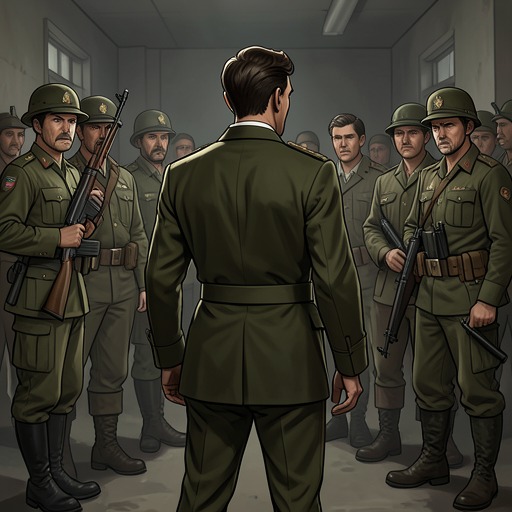
Later, Mazibuko approaches Moroka, Zongu, and Da Costa while putting away gun-cleaning cloths and oil. Still feeling guilty about shouting at Moroka, he asks whether they want some fun and raises the prospect of taking on forty Hell’s Angels. Moroka answers that only one or two of them would be needed, apparently looking for Mazibuko’s approval; Zongu counters that the whole of Team Alpha should go. Mazibuko tells them not to make an issue of it and to gather quietly.
The exchange shows Moroka back among his fellow soldiers and responding to the group’s teasing, competitive mood. His suggestion that a small number could handle the challenge gives him a moment of confidence after the roadside failure and his commander’s rebuke. It also links the unit’s camaraderie to its readiness for action: even a proposed diversion is framed through numbers, opponents, and collective force. The available account establishes the plan to assemble quietly, rather than detailing what follows from it.
Recognition Beneath the Bridge
During a later pause near the river, Moroka is among the young soldiers gathered by an Oryx helicopter. Mpayipheli lies concealed beneath a bridge beside his motorcycle while four soldiers and the co-pilot play at skipping stones. He recognizes Moroka as the young Black soldier who had held a rifle to his head earlier that day. From Mpayipheli’s perspective, the soldiers appear as boys in men’s bodies, competitive and eager to play at being soldiers; he sees in them an image of himself twenty years earlier.
Moroka’s part in this scene is quiet. He leaves the circle without speaking, with a Heckler & Koch UMP slung over his shoulder, and walks down toward the dark water and the bridge. The group does not stop him; its silence indicates that the others understand he wants to be alone. He lingers over the day’s mixed emotions and the remembered pleasure of wandering beneath a bridge as a child. The weapon remains on his back as he moves through this reflective moment, joining the ordinary habit of carrying arms to a brief return to childhood memory.
The Final Confrontation
Moroka notices the motorcycle beneath the bridge only after looking away and then back again. He reaches for his weapon, but Mpayipheli attacks before he can bring it fully into play. During the struggle, Moroka’s UMP fires, and two rounds strike Mpayipheli. The fugitive disarms him and holds him at gunpoint as the other soldiers approach. Mpayipheli says that he does not want to kill him and orders the others to put down their weapons.
Moroka pleads with the soldiers to shoot Mpayipheli, fearing another confrontation with Mazibuko’s anger and the humiliation he had already endured. Mpayipheli strikes him to subdue him but keeps hold of him while directing the others to surrender their weapons. When the situation appears to be under control, he tells the pilot to help load the motorcycle and says Moroka needs to reach hospital. The pilot refuses to fly him anywhere, and Moroka suddenly twists free and dives toward the weapons on the ground.
Mpayipheli tracks Moroka as he grabs a machine pistol and turns it toward him. In that instant, Mpayipheli decides that survival requires him to fire. Three rounds hit Moroka’s protective vest, but another strikes his neck. Mpayipheli immediately orders the others to get Moroka to hospital and load the bike; the priority he states is treatment, not punishment. The final report is brief: Da Costa tells Mazibuko that Moroka is dead, and the radio channel falls silent.
Narrative Role and Significance
Moroka’s two encounters with Mpayipheli form a repeated pattern of sudden violence, but the second does not simply replay the first. At the roadside, Moroka is caught by surprise and later blames himself for failing to anticipate the danger. Beneath the bridge, recognition gives the fugitive and the soldier a shared history within the same day, yet it cannot prevent another confrontation. Moroka’s attempt to seize a weapon after Mpayipheli has ordered the group to disarm turns the struggle toward a fatal outcome.
His death also sharpens the conflict between Mpayipheli’s wish to avoid killing and the conditions of an armed pursuit. Mpayipheli expresses reluctance, gives Moroka a chance to receive medical help, and then fires when Moroka’s movement toward a weapon makes the threat immediate. Moroka is neither only a casualty of the hunt nor merely an obstacle in the fugitive’s path: the apology from Mazibuko, his longing for the day’s sweeter moments, and his fear of renewed humiliation make the soldier’s loss personal to the unit. His brief, unfinished passage from boyhood memory back into armed duty gives the bridge scene its particular weight.